
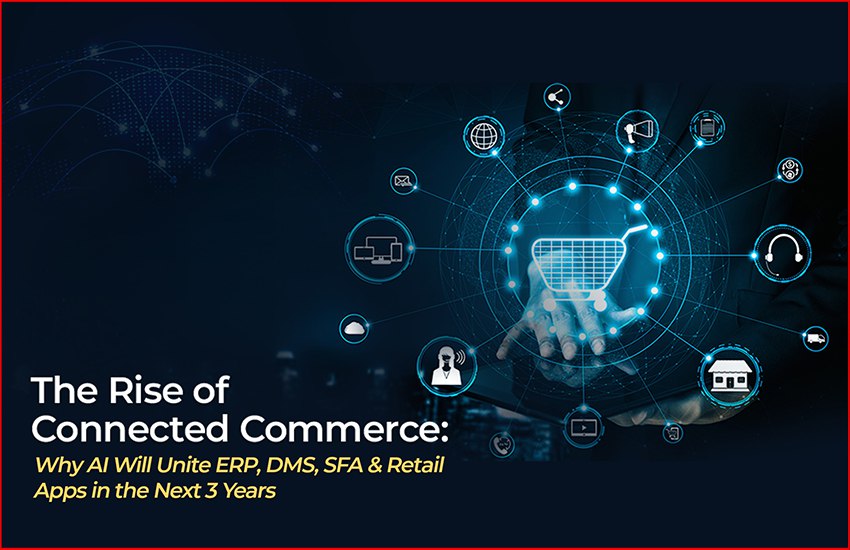
The Rise of Connected Commerce: Why AI Will Unite ERP, DMS, SFA & Retail Apps in the Next 3 Years
Why Connected Commerce Matters Now More Than Ever
For years, brands have worked in disconnected pockets, ERP managing production and finance, DMS taking care of distributor billing, SFA guiding sales teams, and retailer apps doing little more than collecting orders. None of these systems spoke to each other, and that created a familiar Indian–brand problem: by the time information reached the head office, it had already gone stale. But expectations have changed. Brands today are looking for real-time visibility, faster order cycles with cleaner data and tighter pricing control, including smoother communication across their entire value channel. This is however only possible when everything finally works as one connected ecosystem.The Big Shift: Why AI Will Unify ERP, DMS, SFA & Retail in the Next 3 Years
1. Real-Time Visibility Is No Longer Optional
Leadership teams today can’t wait for end-of-month reports, they need to know what’s selling, where, and why in real time. When distributor billing, field updates, ERP stock, and retailer orders finally flow into one place, brands get a single, reliable business picture they can trust every hour. This is the foundation of true connected commerce.
2. Forecasting Will Move From Guesswork to Precision
When systems finally talk to each other, forecasting stops being guesswork. Brands are able to make production plans, and are able to dispatch with greater accuracy using data from past sales, distributor stock, outlet demand, seasonality, and geography trends with far greater accuracy. The outcome comes out to be simple and impactful including fewer stockouts, reduced overstock, and a supply chain that actually runs the way it should.
3. Leakage Will Drop Dramatically
Systems that are broken or not connected often lead to loss in revenue due to masked issues, but a seamlessly connected commerce setup on the other hand, brings them to the surface instantly. This includes any wrong pricing, fake claims made, off-route visits, duplicate orders, or scheme misuse, everything becomes visible the moment data flows together. Patterns are caught early, interventions happen faster, and losses stop before they start.
4. Faster Order Cycles Equalises to Faster Revenue
When ERP, DMS, SFA, and Retail Apps work as one flow, everything simply moves faster. Orders don’t wait, approvals shrink, billing speeds up, collections sync in real time, and dispatches become predictable instead of chaotic. This end-to-end rhythm is what helps brands grow faster, without adding extra people or piling on more tools.
5. Distributors & Retailers Engage More
Retailers today are looking for transparency while distributors want simplicity but at the core, both look for a system that can give them clear insights into stock, schemes, pricing, and delivery timelines. Now, a seamlessly connected commerce ecosystem gives them exactly that: one place where information is accurate, timely, and effortless to access. It strengthens trust, speeds up decisions, and makes daily business smoother for everyone in the value chain.
What Connected Commerce Looks Like in Practice
Picture your salesperson entering a store, updating their visit right at the moment, and within minutes retailer orders. The DMS app they use is able to check live stocks, and can confirm the pricing in real-time from the app, the dispatch takes place and the team is notified instantly without making any additional follow-up calls. One transparent flow without chaos.
How it unfolds:
- Salesperson updates visit
- Retailer places order on app
- DMS validates stock
- ERP confirms price & credit
- Dispatch begins instantly
- Field team gets alerts
- Retailer tracks delivery
This is the future the entire industry is moving towards. And the brands that start building this connected flow today will be the ones setting new standards by 2027.
Why Experience Matters in This Shift?
Anyone can build an app. But connecting India’s distribution ecosystem, with its diverse distributor maturity levels, multi-tier supply chains, cash-based markets, and geographically wide operations,requires experience, trust, and deep domain understanding. With 18 years of working with India’s top brands, we’ve learned:
- What breaks inside distribution
- Where data usually gets lost
- Why field teams struggle
- How retailer adoption actually works
- What Indian distributors truly expect
- How ERP integrations succeed (or fail)
This insight is what powers EAZY’s AI-led connected commerce platform.
The Next 3 Years: What Brands Should Prepare For
1. Unified platforms will replace standalone tools: Brands will shift from 6–7 disjointed tools to one connected stack.
2. Data will become the real competitive advantage: The brand with the cleanest, fastest data wins.
3. Retailer & distributor loyalty will depend on experience: Speed, clarity, and transparency will drive channel preference.
4. Sales teams will rely on automated insights: Targets, beats, visibility, and interventions will be suggested, not manually created.
5. Every business decision will be market-led, not gut-led: Real-time inputs from the ground will fuel decisions at the top.
The Era of Connected Commerce Has Already Begun
AI won’t replace ERP, DMS, SFA, or Retail Apps. It will connect them. In the next three years, this will move from “future trend” to baseline expectation for every brand that wants to scale. And the brands that start early will build the strongest competitive moat.
If you’re ready to see what connected commerce looks like for your business, take a free demo and experience the future before your competitors do.
